

Buyer confidence often depends on what a shopper cannot learn from a still image. An Etsy listing video can show scale, texture, movement, packaging, and real use in seconds, helping people decide whether an item matches their expectations. Used well, video does not replace strong photographs or clear copy. It supports them by making the product easier to understand and the purchase feel less uncertain.
The most effective listing videos are short, honest, steady, and purposeful. They answer practical questions rather than acting as advertisements. Before recording, identify the doubt most likely to delay a purchase: “How large is it?” “What does the material look like?” “How does it work?” “What will arrive in the package?” Build the video around that question, then show evidence clearly.
Why listing video influences confidence
Online buyers cannot hold an item, inspect a seam, test a mechanism, or compare its proportions with familiar objects. Photos can communicate appearance, but they may leave uncertainty about depth, flexibility, weight, finish, or function. Motion gives shoppers another form of information.
A video can demonstrate how a necklace catches light, how a ceramic mug looks when held, how a fabric drapes, or how a digital product appears on a device. It can also reveal that an item is handmade, assembled carefully, or packaged thoughtfully. These signals do not guarantee a sale, but they make the buying decision more informed.
Confidence grows when the video agrees with the listing’s photos, title, description, variations, and policies. If the video presents a color under unusual lighting, shows a size without context, or demonstrates a version different from the selected option, it may create confusion instead. Accuracy matters more than cinematic polish.
Plan the message before recording
A useful video has one primary job. Choose that job before arranging the camera. If you try to show every feature, the result may become hurried and difficult to follow. Select the detail that carries the greatest uncertainty for a first-time visitor.
Match the video to the product
Different products need different demonstrations. For clothing, movement and fit-related details may matter, although a video should not imply a guaranteed fit for every body. For jewelry, close views of scale, clasp action, and shine can be valuable. For stationery, show paper texture, page turning, writing space, or the way a planner opens. For furniture or décor, show proportion, surface finish, and useful angles.
For handmade goods, process footage can establish authenticity without turning the listing into a workshop tour. A brief view of stitching, carving, glazing, printing, or assembly may help shoppers recognize construction details. Show only the process that supports a buying decision.
Digital products need a different approach. A screen recording can show navigation, file organization, editable areas, or the final appearance in a realistic application. Avoid exposing private information, unrelated customer material, or features that the buyer will not receive.
Write a simple shot plan
Prepare three to five planned moments. Begin with the product clearly visible, follow with the most important demonstration, and finish with a stable view that lets the shopper examine the result. A shot plan reduces retakes and prevents distracting improvisation.
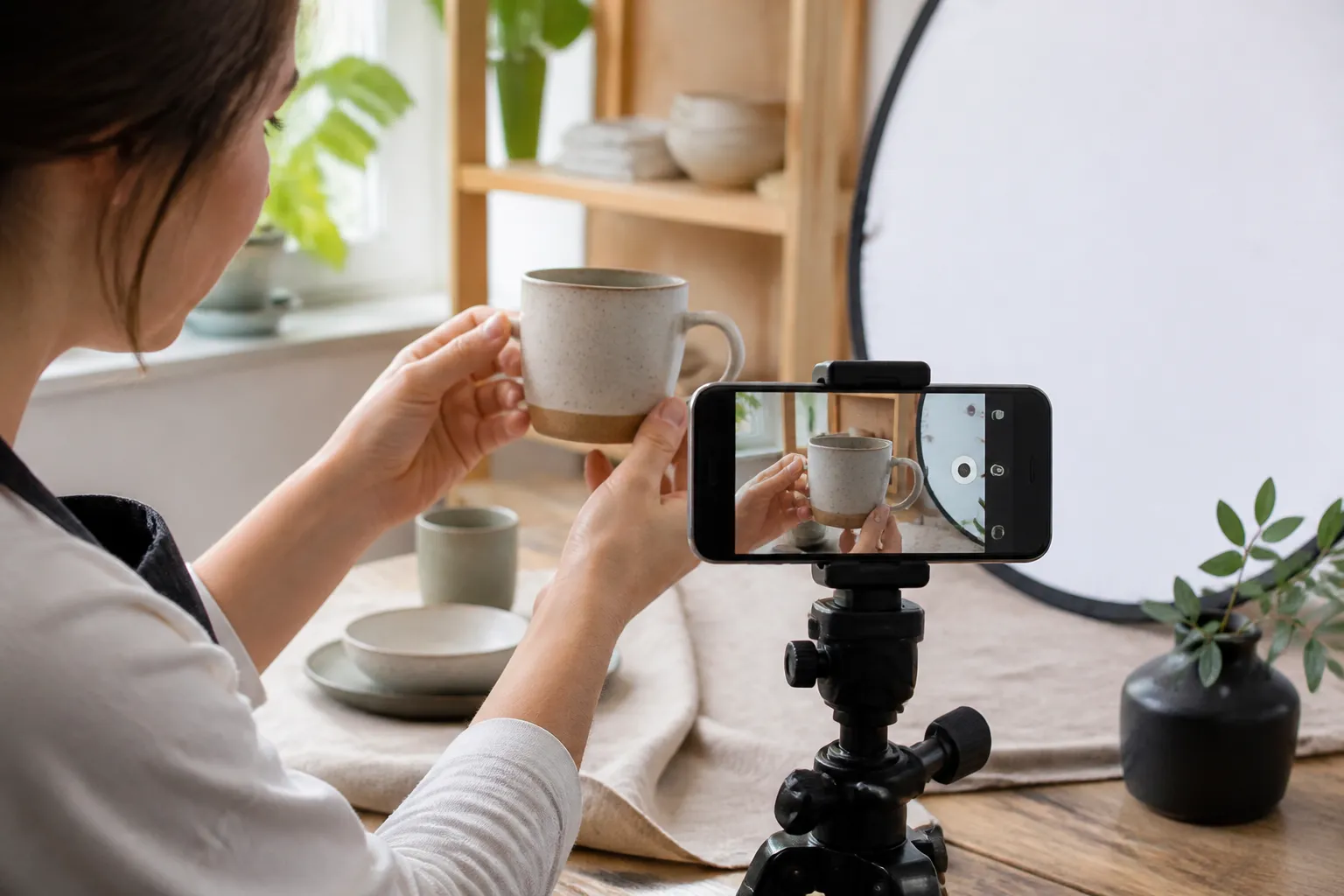
For example, a handmade tote video might show the complete bag, a close view of the fabric and stitching, the interior pockets, and the bag being carried beside an ordinary object for scale. A printable invitation might show the file opening, a design detail, and a printed copy beside an envelope. Each scene should answer a specific question.
Keep the intended viewer in mind. A customer usually wants useful evidence quickly, not a long introduction, personal greeting, or elaborate brand story. Your shop identity can appear through consistent colors, workspace details, or packaging, but the product should remain the subject.
Prepare a trustworthy filming setup
You do not need a complex studio to create a useful Etsy listing video. You do need controlled light, a clean background, and a camera position that prevents misleading perspective. A phone can often capture sufficient footage when it is stable and focused.
Place the product near soft, even light. A bright window can work, but direct sunlight may create hard shadows or change the apparent color. If you use lamps, check for visible color shifts between shots. The goal is not perfection; it is a view that resembles what a shopper can reasonably expect.
Use a tripod, stand, or stable surface. Handheld movement can make small details difficult to inspect and may distract viewers. If you must move the camera, do so slowly and keep the product centered. Clean the lens before filming, because fingerprints can reduce contrast and make a finished item appear hazy.
Choose a background that contrasts with the product without competing for attention. A plain surface is often effective, but “plain” does not mean careless. Remove dust, loose threads, personal documents, and unrelated tools. For a lifestyle demonstration, keep only the objects that provide meaningful context.
Check the recording frame before making the full video. Watch for cropped edges, reflections, clutter, glare, and unwanted appearances. A mirror, window, or shiny surface can reveal more of a room than intended. Also confirm that labels, screens, or package addresses do not expose private information.
Show scale honestly
Scale is one of the strongest reasons to use video, but it must be demonstrated carefully. Place the item beside a familiar object only when that comparison is relevant and accurately sized. A hand, envelope, book, chair, or garment hanger may help, depending on the product.
Do not hold a small product unusually close to the camera and then present it beside a distant object. Perspective can exaggerate size. Keep the product and reference object in a similar plane, or explain dimensions with on-screen text or the listing description. Video supplements measurements; it does not replace them.
Demonstrate details that photographs miss
The best listing video is not simply a slideshow with movement. It reveals qualities that are hard to judge in a still image. Think in terms of evidence: what can the buyer see happening that would otherwise remain uncertain?
Reveal texture and finish
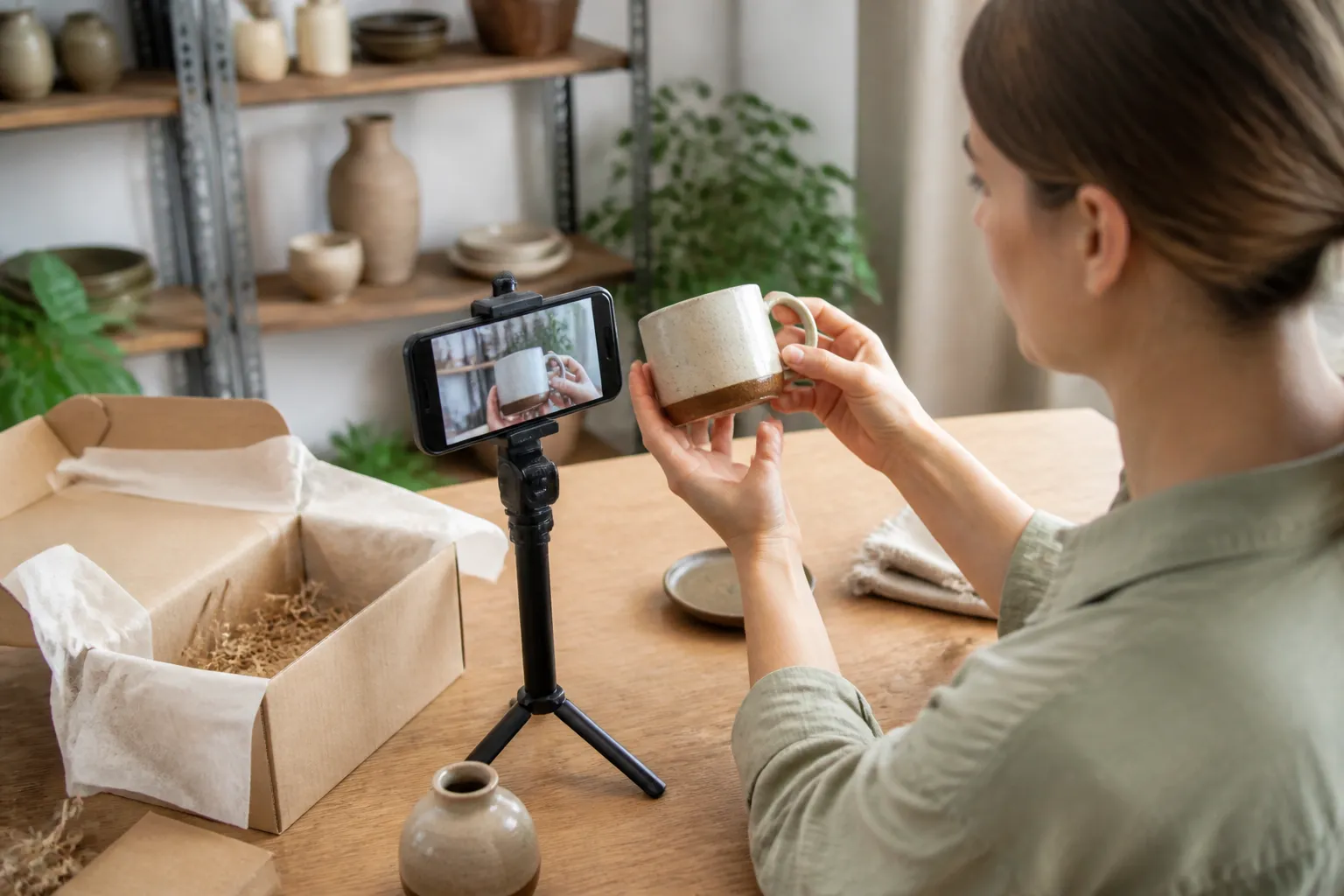
Move slowly across surfaces when texture matters. For wood, show grain and edge finishing. For fabric, let a section fold or drape naturally. For pottery, rotate the piece to reveal glazing and shape. For metal, use lighting that shows finish without creating distracting reflections.
Avoid filters and excessive color correction. A video that looks attractive but changes the product’s actual appearance can damage trust. If lighting makes a color difficult to represent accurately, rely on clear written descriptions and photographs from different angles as well.
Demonstrate function
If the item opens, closes, folds, spins, stretches, fastens, pours, or connects, show that action. Use a deliberate pace and repeat a complex motion if necessary. A shopper should not have to replay a rapid demonstration to understand it.
Keep hands visible when they provide useful context, such as showing how a clasp operates or how a lid fits. Hands can also introduce scale, but avoid covering the feature you intend to display. If the item requires assembly, show the key connection rather than presenting a confusing sequence of every step.
For safety-sensitive or performance-related products, do not imply more than the demonstration proves. A short clip can show operation, but it cannot establish durability under every condition. Describe limitations honestly in the listing.
Include the delivered experience
Buyers often wonder what happens after clicking purchase. A brief view of packaging can answer questions about presentation, protection, and included components. Show the actual standard package rather than a special arrangement prepared only for filming.
If packaging varies by destination, order size, or customization, make that clear in the description. Do not imply that decorative extras, handwritten notes, accessories, or gift wrapping are included unless they are part of the relevant option. Clear boundaries prevent disappointment.
Record with accessibility and clarity in mind
Many shoppers watch without sound, so the video should communicate visually. Use readable text only when it adds necessary context, such as dimensions, material, or a short instruction. Keep words brief and place them where they do not cover the product.
Do not depend on spoken narration alone. If narration explains a feature, show that feature at the same time and provide the essential information in the listing text. Captions can improve understanding, especially when audio quality is uneven or viewers are browsing in a quiet place.
Avoid music that competes with the demonstration. Music may suit a brand-focused clip, but it rarely helps someone inspect a product. If you use audio, keep it subtle and make sure it does not create a misleading mood or distract from important sounds.

The first moments should establish what viewers are seeing. Begin with a complete, well-lit product view or the key action. Avoid several seconds of a blank surface, a hand reaching toward the camera, or an animated logo. Shoppers should understand the subject immediately.
Edit for useful brevity
Editing should remove uncertainty, not hide flaws. Trim setup time, accidental camera movement, repeated scenes, and pauses that do not add information. Keep enough duration for viewers to inspect each important detail.
Arrange scenes in a logical order. A practical sequence is complete product, close detail, function, scale, and packaging. Some products need a different order, but the viewer should never wonder why the camera has moved to an unrelated object.
Use cuts rather than dramatic transitions. A simple edit looks credible and keeps attention on the item. If a feature requires continuity, keep the camera angle steady or make the change obvious. Do not use speed changes to make ordinary actions look more impressive.
Review the final version on a small screen. Details that seem clear on a large monitor may disappear on a phone. Check whether text remains readable, colors look plausible, and the product can be identified without sound. Ask someone unfamiliar with the item what they learned from the clip. Their question may reveal a gap in your explanation.
| Buyer question | Useful footage | What to check |
|---|---|---|
| How large is it? | Product beside a relevant familiar object | Keep objects at similar distance and provide written measurements |
| How does it work? | Slow demonstration of the main action | Show the complete motion without covering the feature |
| What does it feel or look like? | Close movement across texture, finish, or drape | Use neutral lighting and avoid misleading filters |
| What will arrive? | Standard packaging and included components | Separate included items from optional extras |
Connect video with listing optimization
Video works best as part of a consistent listing. Review the title, description, photos, variations, and personalization instructions alongside the clip. The shopper should receive the same answer wherever they look.
If the video shows a feature, name it in the description. If the product has multiple sizes or colors, identify which variation appears on screen. When the video shows a sample, state whether the purchased item will match the sample or be made according to the selected options.
Use the first image and video for different jobs. The primary image should identify the product quickly and attract the right click. The video can then prove details, demonstrate use, or show scale. Repeating the same static view wastes an opportunity to answer a harder question.
Search optimization still depends on accurate titles, tags, attributes, and descriptions, but video does not replace those elements. A shopper must first understand what the item is and find the listing through relevant language. Once they arrive, the video can support confidence and reduce ambiguity.

Do not add claims merely because they sound persuasive. Words such as “luxury,” “perfect,” or “premium” are less useful than visible evidence and specific descriptions. Explain what the buyer can inspect: a reinforced seam, a hinged closure, a matte finish, or a printed sample.
Test the video against buyer objections
Before publishing, list the questions you receive in messages, reviews, custom requests, or abandoned conversations. These questions can guide future clips. If several people ask about thickness, include a side view. If they ask about a clasp, show it opening and closing. If they ask about packaging, film the standard preparation process.
Use an observation checkpoint after editing: ask whether a person unfamiliar with the product can identify its size, purpose, material cues, and included components without guessing. If the answer is no, change the footage or improve the written explanation rather than adding decorative effects.
Review the video whenever the product changes. A new supplier, color, closure, package, template, or production method may make old footage inaccurate. Delete or replace scenes that no longer represent the item being sold. Confidence depends on current evidence.
Track practical signals carefully, but avoid assigning every sale or message to the video. A listing may change photographs, price, keywords, delivery information, or stock at the same time. Treat buyer questions and repeated confusion as useful qualitative feedback, not proof of a single cause.
Common mistakes to avoid
A video can reduce confidence when it looks staged, careless, or inconsistent. Watch for these problems:
- Showing a different size, color, material, or variation from the option described in the listing.
- Using lighting that makes the product color appear substantially different from the photographs.
- Moving too quickly for viewers to inspect texture, function, or construction.
- Adding props that imply an accessory, gift, or feature is included when it is not.
- Filming private information, customer details, addresses, or unrelated screens.
- Relying on music, narration, or tiny text to communicate essential information.
Use video for different Etsy product categories
A single formula does not suit every shop. Adapt the evidence to the reason a buyer may hesitate.
For apparel, show the garment on a hanger, model, or flat surface in a way that reveals structure and movement. Pair the clip with exact measurements and material information. Avoid presenting one person’s appearance as a universal fit guarantee.
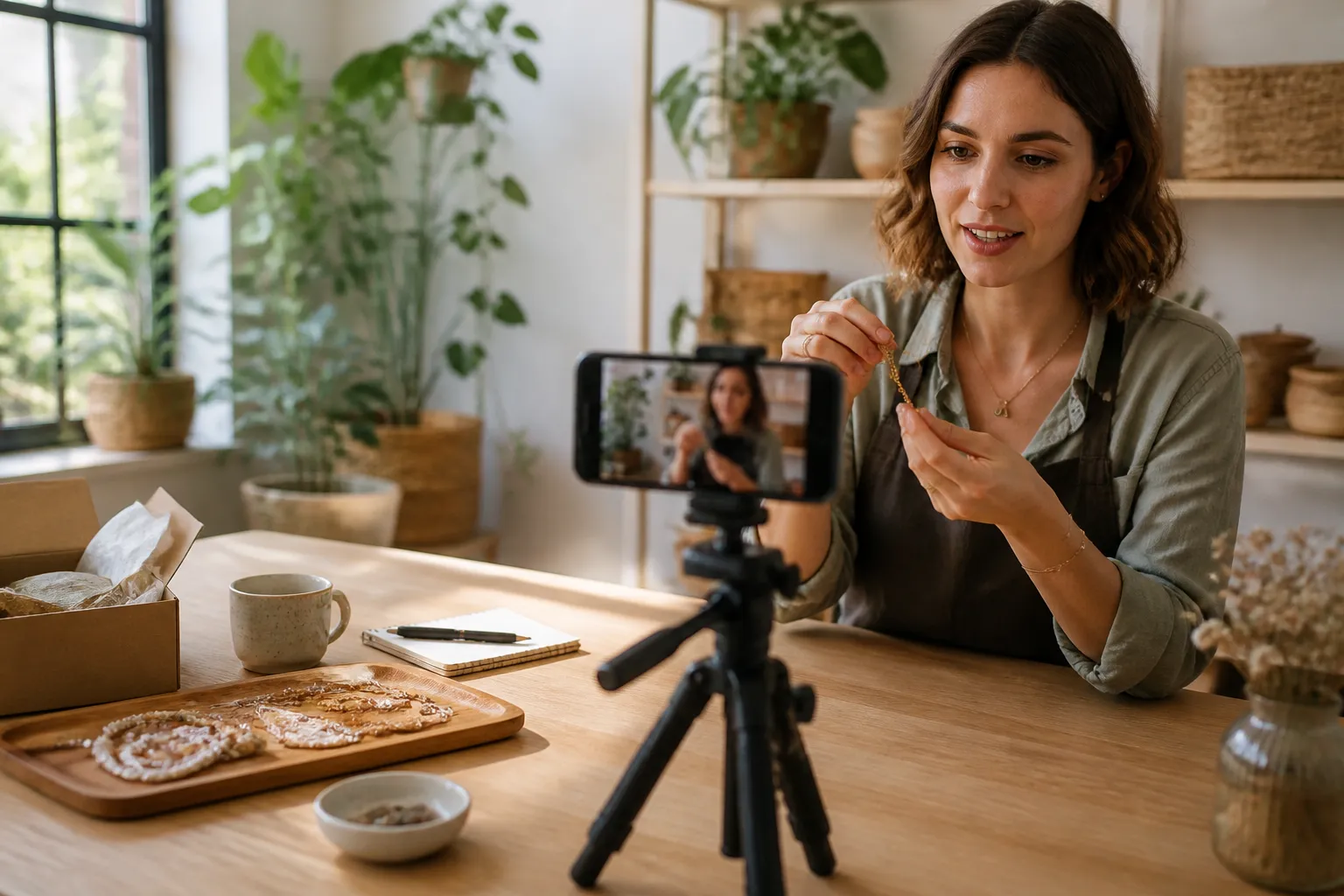
For jewelry and accessories, alternate between a complete view and close details. Demonstrate closures, attachment points, and scale. Reflective surfaces may require several angles, but keep the movement slow enough to show the finish.
For home goods, show how the object occupies space. A lamp, tray, cushion, or wall hanging becomes easier to judge when viewers see it in a realistic setting. Make sure the setting does not hide the item’s edges or suggest uses the product cannot support.
For art and prints, show the full design, then details that demonstrate line quality, paper, or surface treatment. If the item is photographed under glass, manage reflections carefully. Explain whether the displayed frame, mat, or stand is included.
For craft supplies, demonstrate quantity, texture, flexibility, and packaging. If color variation is possible, state that photographs and screens can affect appearance and explain how the product is identified or selected.
For digital downloads, show the file structure or use process while protecting private data. State the file types, software requirements, and what is not included. A polished screen recording cannot compensate for missing compatibility information.
A repeatable publishing workflow
Begin by writing the buyer’s main uncertainty in one sentence. Then select the product detail that answers it and choose a filming angle that makes the evidence visible. Clean the setting, stabilize the camera, and check light before recording.
Record several takes, but compare them for clarity rather than charm. Select the version with the best focus, truthful color, complete action, and least distraction. Edit conservatively, add only necessary text, and review the result with sound off.
Next, compare the clip with the listing. Confirm variation, dimensions, material, package contents, and claims. Watch for details that could be misunderstood, especially props and close-up perspective. Make corrections before uploading.
After the video is live, observe customer questions and messages over time. If people continue asking about one feature, improve the clip or description. If the product changes, reshoot promptly. The process is not a one-time decoration; it is part of maintaining accurate buyer information.
Practical tip: Before publishing, watch the clip once with the sound muted and once at a small size. If the product, main action, and key context remain clear in both views, the video is doing useful informational work.
Frequently asked questions
Should every Etsy listing have a video?
Not necessarily. Video is most useful when motion, texture, scale, construction, packaging, or function adds information that photographs cannot show easily. A simple item may need only strong images and precise details, while a complex or tactile product can benefit greatly from demonstration.
How long should an Etsy listing video be?
Use the shortest length that communicates the main evidence clearly. There is no universal ideal duration for every product. A quick scale demonstration may be brief, while a product with several functions needs more time. Remove any scene that does not answer a buyer question.
Should I show myself in the video?
Only if your presence helps explain use, scale, or process. You do not need to appear for a video to feel trustworthy. A steady product demonstration can be more useful than a talking introduction. If you appear, keep attention on the item and avoid claims the footage cannot prove.
Can I use the same video for several listings?
You can reuse footage when the products, variations, and claims genuinely match. Do not use one clip across listings if it shows a different size, color, package, or included component. A reusable process scene may work, but label the product-specific details accurately.
Should I add text overlays?
Add text when it clarifies information that may be missed without sound, such as a measurement, material, or variation. Keep it short, readable, and consistent with the listing. Do not cover the feature being demonstrated or fill the frame with sales language.
What if my phone video looks imperfect?
Technical perfection is less important than clear, truthful evidence. Improve the biggest problem first: stabilize movement, correct harsh light, clean the lens, or simplify the background. Avoid filters that alter appearance. An honest, understandable clip is more valuable than a glossy but misleading one.
How can video support Etsy SEO?
Video does not replace accurate listing language, categories, attributes, or tags. Its main role is helping visitors understand the product after they reach the listing. Use the written content to describe the item plainly, then let the video demonstrate details that support those descriptions.
What should I do if the video reveals a flaw?
Decide whether the mark is a normal characteristic, a defect, or a production issue. If it affects the item, correct the product or explain the condition honestly before publishing. Hiding a relevant flaw may create returns or disappointment. Transparency protects confidence better than selective filming.
Can packaging footage improve trust?
It can, when it accurately represents the normal delivery experience. Show the standard protective materials and included components, but do not imply that optional wrapping or props come with every order. If packaging changes by order type, explain the difference in the description.
Conclusion
An Etsy listing video increases buyer confidence when it replaces guesswork with visible, accurate evidence. Start with the question most likely to delay purchase, demonstrate the answer slowly, and keep the footage consistent with every other part of the listing. Good lighting, stable framing, honest scale, readable context, and careful editing matter more than expensive equipment.
Publish only what the customer will actually receive. Then use questions and confusion as signals for improvement. A short, truthful demonstration can make a handmade object, physical product, or digital file easier to understand—and a clearer purchase is usually a more confident one.